jueves, 27 de octubre de 2011

CONSTANTINO EL GRANDE (RELIGIÓN)

Constantino era hijo de Constancio Cloro y de Santa Equia-postólica Elena. En el año 306 fue proclamado emperador.
En el año 312 surgió la guerra contra Majencio. Antes de un combate decisivo, Constantino vio en el cielo un brillante signo de la santa Cruz con las palabras que le acompañaban: "Con ésta vencerás." De noche le apareció en sueños el Salvador y presagió la victoria. Constantino ordenó confeccionar la imagen de la Cruz sobre todos los estandartes. En la batalla que sobrevino, Constantino ganó una decisiva victoria.
Después de convertirse en el único emperador romano, Constantino dedicó toda su vida al servicio del cristianismo. Declaró la libertad de confesión de la fe cristiana (313), puso fin a los juegos y holocaustos paganos, otorgó privilegios al clero y a las iglesias, confirmó la santificación del día domingo, construyó numerosos templos cristianos y derogó las leyes gentiles dirigidas contra el cristianismo.

EL PRIMER OBISPO DE JERUSALÉN

El primer obispo de Jerusalén fue El Apóstol Santiago quien se desempeñó como presidente del Concilio de Jerusalén en el año 51, lo que demuestra que el Apóstol Pedro no se consideraba como primero exclusivo entre los apóstoles. El Apóstol Santiago llevaba una vida santa, era virgen, no comía carne, no bebía vino y frecuentemente rezaba en el templo de Jerusalén prosternado sobre tierra en oración; por eso la piel de sus rodillas se hizo muy dura.
Los judíos le llamaban el justo. En el transcurso de 30 años reforzó y difundió la fe en Jerusalén y en toda Palestina entre muchos miles de judíos (Hech. Ap. 21:20).

THE FOURTH VOYAGE

 
The king and queen freed him and even gave him money and ships for a fourth voyage. This one left Spain in 1502 and sailed to the island of Martinique and then to Honduras, in Central America. After more exploring in the Caribbean, Columbus returned home to Spain (he was sick), in 1504. He died two years later, still believing he had reached Asia.
The Fourth Voyage: towards the interior of Colombia
Sebastian de Belalcazar took charge of the fourth stage of the Conquest. He was already founder of Quito. After that, he followed his way to the north and founded Popayan and Cali in 1536. Nicolás de Federman came from Coro, Venezuela and founded Rioacha.
This stage took place in the inner part of the country, looking for The Dorado. It was a strategy of the indigenous tribes to get rid of the Spanish. They left looking for a city made of gold. Gonzalo Jimenez de Quesada started this stage in the North and founded Santa Fe de Bogota in 1538.

miércoles, 26 de octubre de 2011

THE EARTH

The Earth, our planet, is composed by three kinds of materials distributed in layers. These layers can be gaseous, solid or liquid.
Gaseous Layer:
It forms the atmosphere that surrounds the planet. The atmosphere has several zones defined as troposphere, stratosphere, mesosphere and ionosphere.
Solid Layer:
It’s formed by the crust, the mantle and the core.

Liquid Layer:
It is also called Hydrosphere. It’s the mass of water found on, under and all over the surface of the Earth.

MOON MOTIONS

ROTATION:
It is the movement made by the moom around its own axis. It takes 27 days, 7 hours and 43 minutes.
ORBITAL MOTION:
It is the movement made by the Moon around the Earth. It takes 29 days, 12 hours and 44 minutes.
REVOLUTION:
It is the movement made by the Moon around the Sun at the same time than the Earth.

STATISTICS (MATH)

A continuación encontrarán información sobre lo trabajado hoy (día 2) en la clase de math. Por favor realizar las actividades.

https://docs.google.com/document/d/1t0KOhotHccgmfj1_drNymyustYSjRKhRQarj0lM8j-c/edit

lunes, 24 de octubre de 2011

THE MOON

THE MOON
The Moon is the only natural satellite of Earth. It is the nearest celestial body to our planet. The Moon is the only celestial body on which human has landed.
Characteristics of the moon:
1.    It is a solid body, with a spherical shape.
2.   It has not light on his own. Its brightness is the reflection of the sunlight.
3.   There is not water or air in it.
4.   It does not have atmosphere.
5.   Its size is a quarter of the Earth’s size.
6.   It presents smooth dark zones and clear zones.
7.   Its dusty surface is covered with deep craters.
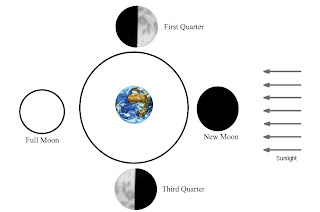
PHASES OF THE MOON
The Phases of the moon are the different aspects that the Moon takes due to the reflected light on its surface. This aspect changes constantly during a month. There are 4 basic phases of the Moon.

1.    First Quarter:
At this moment the dark diminishes, while the enlightened zone increases constantly. The half of the surface is enlightened.
2.   Full Moon:
In this period, the Moon surface is enlightened completely.
3.   Last quarter:
In this phase we can see that the enlightened face diminishes, while a dark shadow covers the half of the surface.
4.   New Moon:
In this period the Moon face becomes completely dark, to appear later, slowly.