jueves, 3 de noviembre de 2011

ACTIVITY TO FINISH AT HOME

Complete the chart.
How many flat surfaces, edges…. Etc, each solid figure have?
SOLID FIGURE
FLAT SURFACES
CURVED SURFACES
EDGES
VERTICES
1.    CUBE


2.    RECTANGULAR PRISM


3.     SQUARE PYRAMID


4.     CYLINDER


5.     SPHERE


6.     CONE


ACTIVITY ABOUT AREA AND PERIMETER

En el siguiente link encontrarán la actividad de Área y Perímetro que se trabajó en clase el 2 de Noviembre.

https://docs.google.com/document/d/1eyzQ95-uJOpE97pwnFPIYaYLKHowhrZ69ZFMwjpQGYM/edit

PERIMETER AND AREA

PERIMETER:  Is the distance around a plane figure. We have to add the lengths of the sides to find the perimeter.
AREA: Is the number of square units needed to cover a surface. You can count the number of squares units to find the area. You can find the area of a rectangle by multiplying the length by the width. It is measured in square (Sq) units; some of these units are: squared centimeters (Cm2); squeared metres (m2) and squared kilometers (km2).
Example:

miércoles, 2 de noviembre de 2011

THE EARTH’S MOTION

THE EARTH’S MOTION

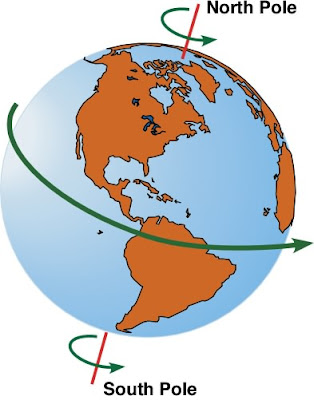
1. ROTATION: It is the movement made by the Earth when it spins around its own axis, creating the day and night cycle. This movement lasts 24 hours. When the Earth rotates, a half of the planet is always enlighten, while the other half is dark.


1. REVOLUTION: it is the orbital motion made by Earth turning around the Sun. it takes 365 days and 6 hours. This time period is called a YEAR.
Civil Year: it has 365 days and 6 hours.
Leap – year: it has 366 days and happens every four year.

LAYERS OF THE EARTH

1.       Atmosphere: it is the gaseous layer surrounding the Earth planet. It is made of several gases, mainly Nitrogen and oxygen.

2.       Hydrosphere: It is the huge mass of water that covers three quarters (3/4) of the planet surface. The Hydrosphere is essential for maintaining living things cycles and nutrient cycles in the planet.


3.       Crust: it is a layer extending from the surface to 33 km deep. It is divided in 2 parts: the Upper zone (forming the continents) and the Lower zone.

4.       Mantle: it is an intermediate layer situated between the lithosphere and the core.

5.       Core: this part of the Earth is unknown because nobody have reached that deep inside. It has a high temperature coming from the remaining heat on planet formation and decaying radioactive elements.

jueves, 27 de octubre de 2011

CONSTANTINO EL GRANDE (RELIGIÓN)

Constantino era hijo de Constancio Cloro y de Santa Equia-postólica Elena. En el año 306 fue proclamado emperador.
En el año 312 surgió la guerra contra Majencio. Antes de un combate decisivo, Constantino vio en el cielo un brillante signo de la santa Cruz con las palabras que le acompañaban: "Con ésta vencerás." De noche le apareció en sueños el Salvador y presagió la victoria. Constantino ordenó confeccionar la imagen de la Cruz sobre todos los estandartes. En la batalla que sobrevino, Constantino ganó una decisiva victoria.
Después de convertirse en el único emperador romano, Constantino dedicó toda su vida al servicio del cristianismo. Declaró la libertad de confesión de la fe cristiana (313), puso fin a los juegos y holocaustos paganos, otorgó privilegios al clero y a las iglesias, confirmó la santificación del día domingo, construyó numerosos templos cristianos y derogó las leyes gentiles dirigidas contra el cristianismo.

EL PRIMER OBISPO DE JERUSALÉN

El primer obispo de Jerusalén fue El Apóstol Santiago quien se desempeñó como presidente del Concilio de Jerusalén en el año 51, lo que demuestra que el Apóstol Pedro no se consideraba como primero exclusivo entre los apóstoles. El Apóstol Santiago llevaba una vida santa, era virgen, no comía carne, no bebía vino y frecuentemente rezaba en el templo de Jerusalén prosternado sobre tierra en oración; por eso la piel de sus rodillas se hizo muy dura.
Los judíos le llamaban el justo. En el transcurso de 30 años reforzó y difundió la fe en Jerusalén y en toda Palestina entre muchos miles de judíos (Hech. Ap. 21:20).